The heart of the traditional Seder rests on a bunch of puns – which seems particularly appropriate for this year, as our Passover begins on April Fools’ Day.
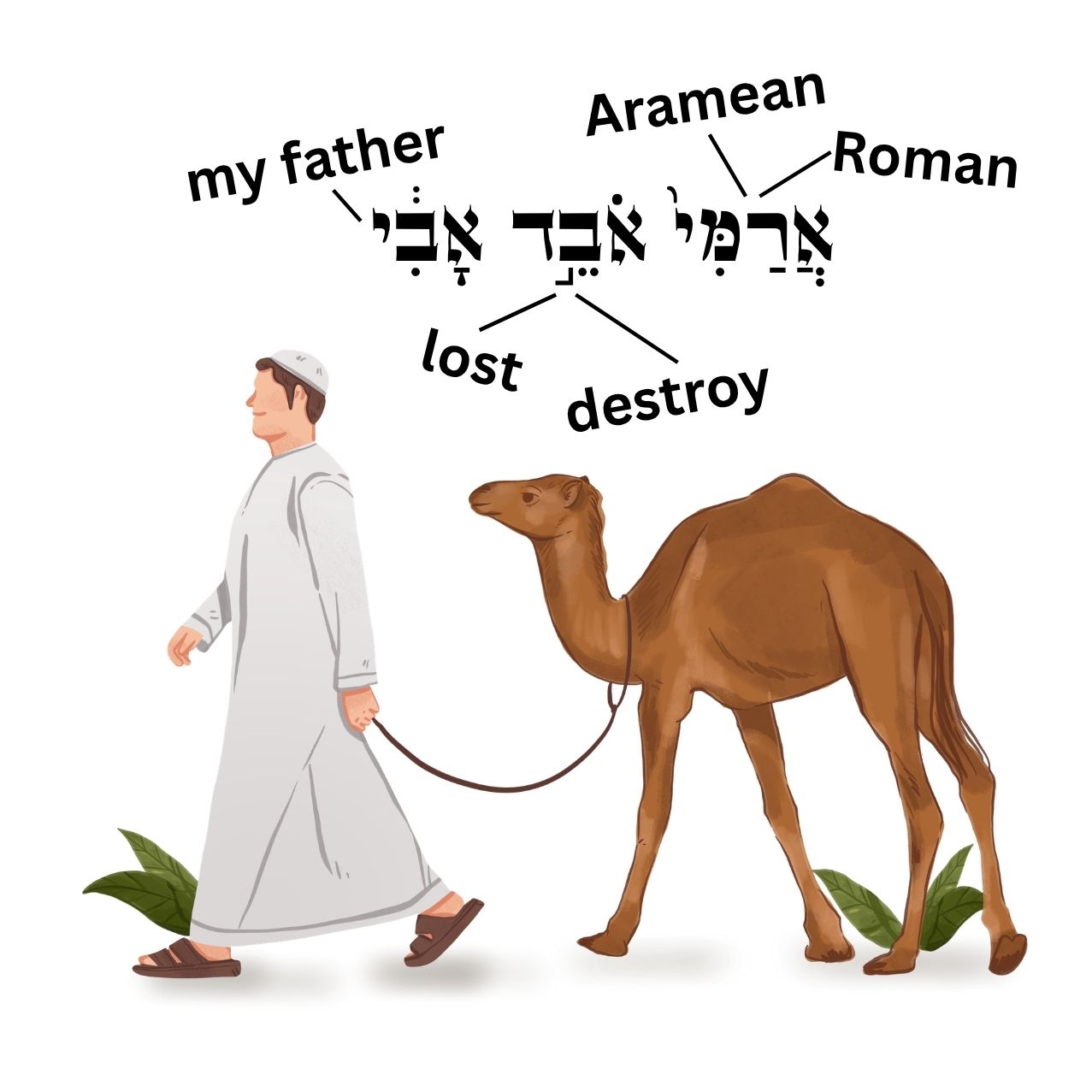
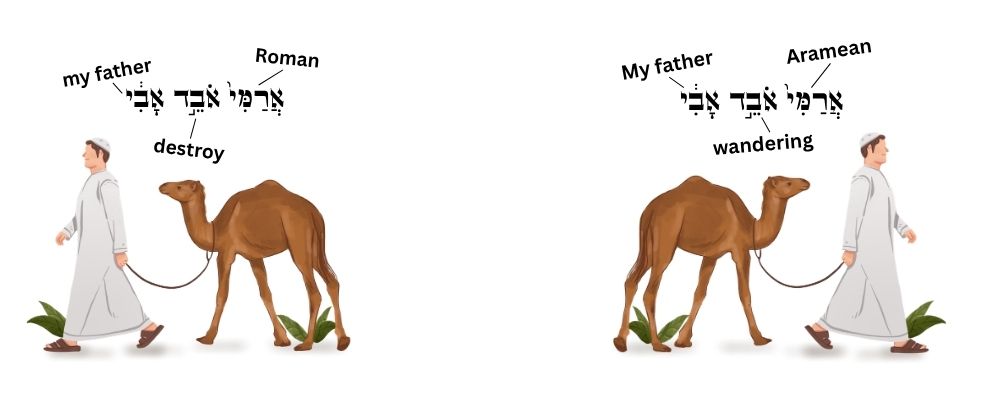
These puns surround the phrase Arami oved avi אֲרַמִּי אֹבֵד אָבִי.
Most haggadahs which include this passage these days translate the statement in its plain meaning: “my father was a wandering Aramean, who went down to Egypt.” The wandering Aramean would be Jacob, who went to Egypt with his family. But the original Haggadah text insists the Aramean was Jacob’s uncle Laban, who they say was worse than Pharaoh, because he tried to destroy our father Jacob, and our entire people with him!
You see, the word “oved” could mean “wandering,” but it can also mean “loss.” It’s a bit of a forced pun, but it serves their purpose.
And what purpose could that be? The answer is in a much simpler pun: “Arami,” to a second-century Judean would sound much like “Romi.” For them, the oppressors were the Romans, who destroyed the Temple in Jerusalem, and proceeded to restrict the study of Torah – threatening to destroy us all!
The Rabbis who created the Passover haggadah weren’t really concerned with the ancient history of the Exodus. They were much more interested in the living myth of it. They were moved by the idea that if we were once enslaved in Egypt and became free, then there was reason for them to have faith that their own oppression by the Romans would one day come to an end. And when they instruct us to affirm that “in every generation we must each see ourselves as if we, personally, were redeemed from Egypt,” they are challenging us to imagine ourselves liberated from the oppression that we experience in our own time.
War, antisemitism, challenges to democracy, and the particular ways each of us might feel tied down and oppressed by life… the rabbis are encouraging us to have faith that all these will pass. We survived Pharaoh and Caesar, and we will survive this as well. “Once we were slaves, now we are free. This year we are in exile,” – in this imperfect, broken reality, “next year in Jerusalem” – in the perfect world where all contradictions are resolved, and all oppression is gone!
With these deep stories, but also with songs and silly games of hide-and-seek (which we all know are not just to entertain the children!), and good conversation loosened by a little wine, the seder seeks to shake up our thinking, and liberate us from mental ruts of habit and cynicism and canned answers. So we might be able to truly say “I believe, with utter faith, in the coming of the Messiah” – that a better world is, indeed possible!
Chag sameach, and may your Passover seders this year be playfully liberating,
Reb Josh