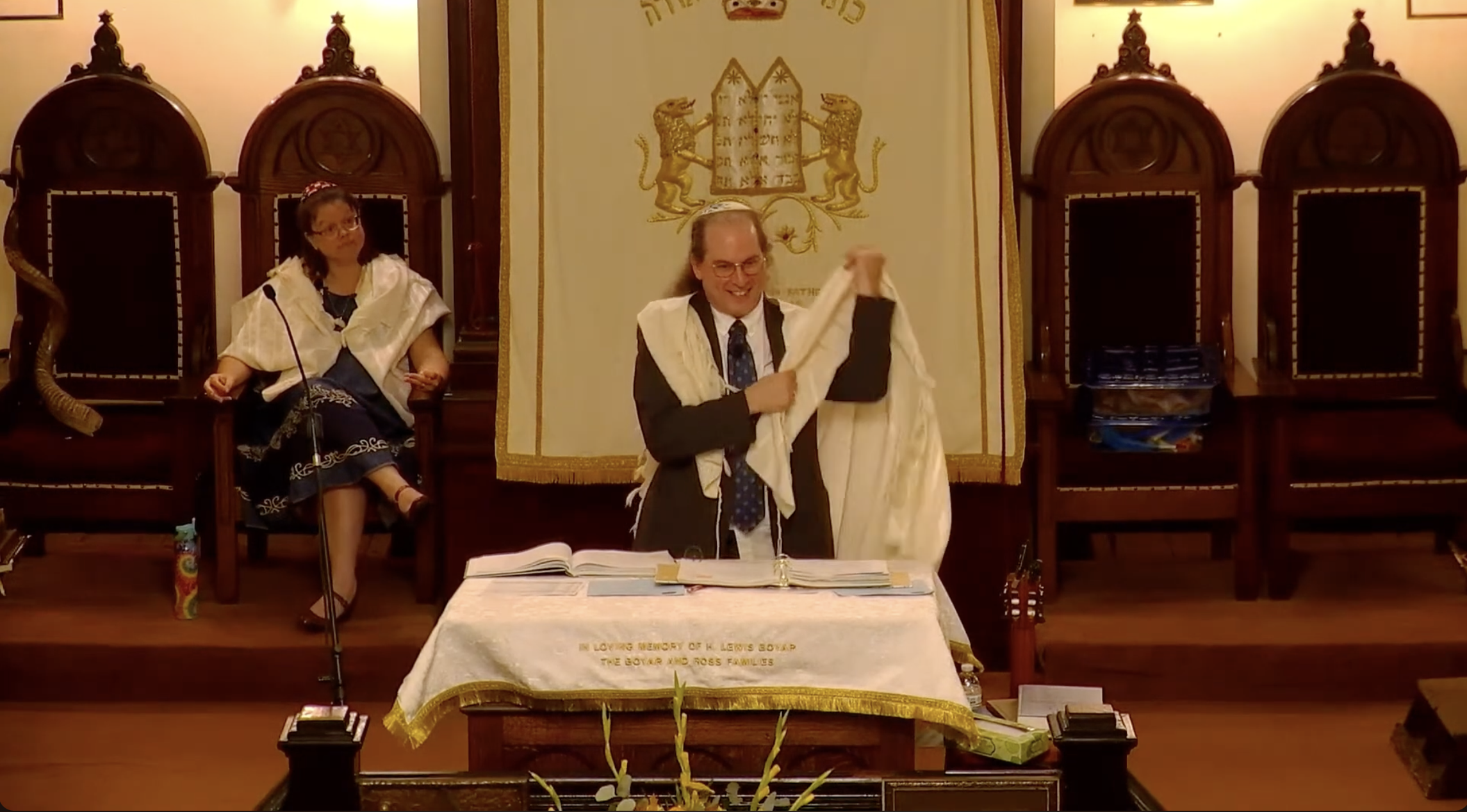
Here are the (lightly edited) notes for the sermon I gave on Erev Rosh Hashanah 5787 (2026). Scroll down for the video of how it actually turned out. ~js
Once, when I was just getting my start in Jewish education — teaching Hebrew School because, well, I grew up in Israel and happened to know Hebrew — I witnessed a congregant come up to the rabbi of the congregation where I was working and say, quite emphatically: “Rabbi! I don’t believe in God!”
Without getting flustered, the rabbi just looked at him and said, “Huh. Your faith is a lot stronger than mine.”
The fellow was, understandably, taken aback for a moment,so the rabbi explained: “I’m not sure if God exists or not. But you seem to be quite certain that He doesn’t. But tell me about this God you don’t believe in. Because chances are, I don’t believe in him either.”
I don’t remember how the conversation continued, but from that exchange I learned three things:
A lot of us see God in nature – whether in a majestic sunset, or a simple walk in the woods. A lot of us see God in relationships: in the famous words of Jean Valjean “to love another person is to see the face of God!” Some of us seek God through altered states: meditation, prayer, dance, or live music. Some of us might find a spiritual anchor in God’s particular relationship with the Jewish people. You might have a personal relationship with God – a sense that you have an ongoing conversation (or argument) with the Master of the Universe. Or, you might believe wholeheartedly in a God who literally judges us on Rosh Hashanah and sentences us on Yom Kippur… And maybe you have your own ways of thinking about God that I haven’t mentioned. These were, after all, just a few options by way of example.
One of the things that fascinates me about the concept of God
is that we might believe several mutually exclusive things at once.
For example:
If the Taunton High football team is playing Bridgewater-Raynham,
most of us would agree,in a moment of serious theological reflection, that God isn’t going to take one side or the other. But if we’re committed fans, we’ll still be praying for our side to win! Note that I didn’t use the example of the Red Sox and the Yankees, because I recognize that there would likely be some deep theological convictions about that.
I personally tend to take my conflicting theologies one at a time — and lately they’ve been changing on me like quicksilver. One moment, God is no more than a profound symbol for the immense and impersonal universe, or else a good excuse to notice myself, or to sing with other people — not a literal “person” or even a “thing” at all, and the next moment I might be addressing the most compassionate and understanding Divine listener, with tears of longing and gratitude streaming down my face. Okay, so that was a particular experience at a Jewish meditation retreat. But on some level that kaleidoscope of experience around God is happening all the time when I pray. In fact, I think it’s baked into our liturgy — we say God is One in our tradition, but we also say the Torah has seventy faces, and so does God!
Here’s a challenge: See if you can count how many different concepts of God, how many different images or descriptions come up in our machzor (the High Holiday prayerbook) we’re using, and let me know how many you found after the service.
But to understand all of that variety we have in our prayerbook, I want to take a few moments to look at one blessing, maybe the most humble blessing, that we all know:
בָּרוּךְ אַתָּה ה׳ אֱלֹהֵינוּ מֶלֶךְ הָעוֹלָם הַמּוֹצִיא לֶחֶם מִן הָאָרֶץ
Blessed are you God, ruler of the Universe, who brings bread out of the earth.
Now, the classic way to look at that blessing is:
But what if I don’t believe in God? Or if I’m not in a God-believing mood right now, or that’s not the God I believe in – a God who literally creates bread. That’s just biology and chemistry. Then what’s the point of saying the blessing?
Well, my friend Rabbi Tzemah Yoreh doesn’t believe in God! Well, he says he’s agonistic now. But he used to be an atheist. He’s a Humanist rabbi, and what he does believe in holiness.
This how Rabbi Yoreh blesses bread — I found this in his Humanist Prayer Omnibus:
Sweat drops from a farmer’s brow
On to my plate
If I forget thee o laborer,
May I forget my right hand,
For in thee I am truly blessed.
… “I am truly blessed”… Rabbi Yoreh doesn’t need God to feel blessed – to have holiness in his life. He takes a moment to appreciate the laborer, who he sees as the source of his bread, and in that moment he makes room for an awareness that’s beyond stuffing his face. You can do it too, even without his poetry:
All you have to do is pick up a piece of bread and say to yourself before you bite into it, “Man, I love bread!” (Or chocolate. Or cheese). That’s a great mindfulness practice! It brings you into the moment – into your actual experience of eating. Ever tried to eat a meal and really notice every bite? I learned to do this on my meditation retreats. It’s harder than you might think! We usually barely even taste our food – we just shovel it into our mouths. So, taking just one moment to appreciate our food before eating it…that’s a real spiritual practice, whether you mention God in the process or not.
So that naturally raises the question: why bring God into it at all? If all the blessing for bread is, is a moment of mindfulness, then what’s the point of mentioning God at all?
I make sense out of it with a math analogy. Now, if you’re the kind of person who checks out, as soon as math comes into the picture. Feel free to tune out for a few moments, I’ll let you know when it’s safe to tune back in.
I remember when I was in eighth or ninth grade, and the teacher demonstrated on the board how the quadratic formula was derived. It was one of those things I could just barely follow. But I remember this one thing: at some point there was an equation you couldn’t do much with. It seemed like no matter how you manipulated the equation, it didn’t become any simpler or easier to solve. But then the teacher added the same thing to both sides of the equation–which we know doesn’t change anything–but suddenly the problem made more sense!
So that’s how sometimes I think of blessings. Mathphobes, you can tune back in now. I could have a simple statement: “The world is pretty great, because it has bread in it!” Or I could say: “God is pretty great – because God makes bread possible.” And then you do that with a whole lot of things, like light, and love, and creation, and redemption:
God is pretty great – because God created the world, and rolls day into night and the night into day, and is the power that frees the captive and gives strength to the weary. And I put my trust in God when I go to sleep!
And I thank God when I wake up! And my world starts to become suffused with a sort of holiness that’s harder to access without the concept of God.
So I thank God for this holiness practice we call Judaism –
ברוך אתה ה׳ אלהינו מלך העולם אשר קדשנו במצוותיו וציונו
God is pretty great – because God makes us holy through directing us to light the Shabbat candles, or to listen to the shofar, or to build a sukkah, or to engage with the seventy faces of Torah, to engage with the holiness of this tradition.
So whenever I’m in a not-God mood, I can factor God out of both sides of the equation: “The world” or “our tradition” is pretty great because… whatever the blessing is.
But then I can factor God back into both sides of the equation–whether I believe in God or not, and I get this added sense of holiness. Because at the end of the day, I think the holiness is what we’re after. It’s a particular sort of holiness that we don’t get unless I bring religion into our lives–or, at least *I* don’t get this sort of holiness in my life without religion. My father says he gets it from playing Bach.
Now, I bet some of you are thinking: I love being part of this religious community, and I really don’t care about bringing holiness into my life! I don’t come to services for God! Maybe I come to services to be intellectually stimulated–maybe the rabbi has something interesting to say (one can hope…!) Or, more likely, I come to services to see my friends! To be part of the community! And do you even need to come to services to be part of the community?
You could come to Brotherhood and Sisterhood events. Or, better yet – if you really want a sense of community, you can join the folks who make the events happen! You could be a parent, involved in bringing your kids to the Religious School, and engaging in the community of learning with the teachers and the other parents.
Or you could one of the folks who comes to adult education, like Lunch & Learn, or book group, or the Judaism 101 class we’re going to get up and running once the holidays are over.
Or you could be one of the folks caring for your fellow congregants , visiting the sick, and organizing meal-trains–if this is you, seriously, come talk to me! It’s very holy, rewarding work, and we could use some help.
Or maybe …maybe there’s something else that you’d love if we did, because if we did that, you’d certainly come around more often!
I really believe there’s holiness in the connections we make with each other, just as much as in the connections we make with God in our prayers.
There’s a group of folks in this community whose way of connecting is by doing the behind-the-scenes work, that keeps the lights on and makes it all happen that I’d like to recognize. Will members of the the Board of Directors, please stand up? And folks involved with the Sisterhood and the Brotherhood. Without these folks and all their hard work we’d have no congregation.
The board is working on figuring out where we need to go next. Remember when I mentioned that thing, that if we did it, you’d want to come more often? Well, they want to know what that thing is, and also what’s keeping you connected already, and also what you think we could be doing better.
so – members, if you open your New Year’s Greeting Book to page 4, you’ll see there’s a simple 3-question survey there. Please go to agudathachim.org/survey, and complete the survey to let us know what you think! We’re looking for 100% participation – or as close to it as we can get.
If you don’t feel like writing your thoughts down, we’d be happy to give you a call, or get together for a cup of coffee, and hear what you have to say.
And if you’re curious what your fellow congregants think, we’re also looking for folks to help make those phone calls, so let me, or any member of the board know, or call Lori in the office and let her know, and someone will reach out to you after the holidays, and we’ll get started.
So how did we get here from God??? There’s a theme – I promise! What I’m trying to say is, in whatever way is right for you to engage, know you are welcome here in this community. In whatever way, or ways, you conceive of God and the meaning of the High Holiday rituals, please know that your beliefs, doubts, and questions, are all welcome here.
Thank you for being here. I look forward to our journey together through these High Holidays, and through the year — and years — to come.
Shanah Tovah u’metukah – may we all merit a good and sweet year!
Reb Josh


