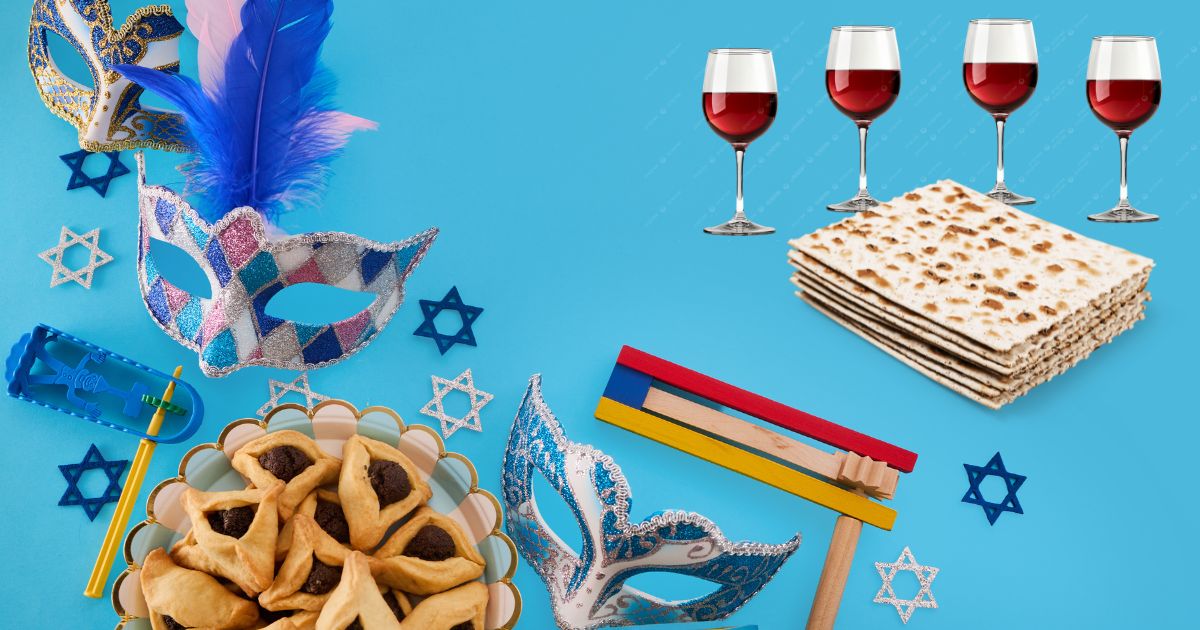
If that’s not what all Jewish holidays are about, certainly the two major spring celebrations, Purim and Passover, fit the bill. And yet, we don’t tend to think of them as similar. My father’s habit of conflating Purim’s tradition of excessive drinking with the four cups of Passover wine (which he insists are a minimum requirement!) aside, Purim is supposed to be a rowdy public party, while Passover is a leisurely evening of food and conversation at home. The stories they each tell are also deeply different, but in ways that might not be obvious, and which I would like to suggest shed light on each other.
The story of our liberation from Egypt, especially as it is told in the seder, is one of un-earned liberation, effected entirely by the Divine strong arm and outstretched hand. ״Had God not taken our ancestors out of Egypt,” we say, “then we, our children, and our children’s children would still be slaves to Pharaoh in Egypt.” Even the human agency of Moses is left out of the traditional Haggadah, leaving the impression that our ultimate redemption is as inevitable as the emerging green buds of spring. Our job is merely to notice and celebrate the quickening of life.
By contrast, the Scroll of Esther is the only book in the Bible that doesn’t mention God even once. Instead, the drama unfolds entirely as an interaction between the very human characters of the story, without a prophet, patriarch, or matriarch receiving assurances of the Divine will. Rabbis and scholars see God acting in a variety of points in the narrative, but lately I’ve become drawn to a particular moment in chapter four.
At this point in the story, Haman has already made his evil plot, and Mordecai asks Esther to intercede with the king. When she balks at the mortal risk of approaching the great Ahashverosh unbidden and revealing her Hebrew identity, her uncle chastises her. “Don’t imagine that your status as queen will save you from the fate of your people,” he warns. “On the contrary, if you keep silent in this crisis, relief and deliverance will come to the Jews from another quarter, while you and your father’s house will perish.” And here Mordechai relates to the Divine plan much as you or I might: ”who knows,” he says ”perhaps you have attained to royal position for just such a crisis.” Understanding the assignment, Esther takes decisive action, as she carefully maneuvers to win the king away from Haman’s influence and save her people. After Haman’s downfall, the Megillah revels in increasingly hyperbolic descriptions of violent triumph, which we traditionally commemorate with giddy exuberance.
Ultimately, the biggest difference between Purim and Passover, is that Purim is a time to party, and Passover is a time to ask questions. Put side by side, the two stories invite us to ask ourselves: are we always called to act, as Esther did; to fix the problems we see around us? Or are there times when we should stand back and let life unfold as it will? When are we called upon to risk everything, and when is discretion the better part of valor? Are these the only options we have? And what questions do we ask ourselves, to tell us what path we should take?
Wishing you joyous celebrations of both holidays,
Reb Josh


