Ways of Peace

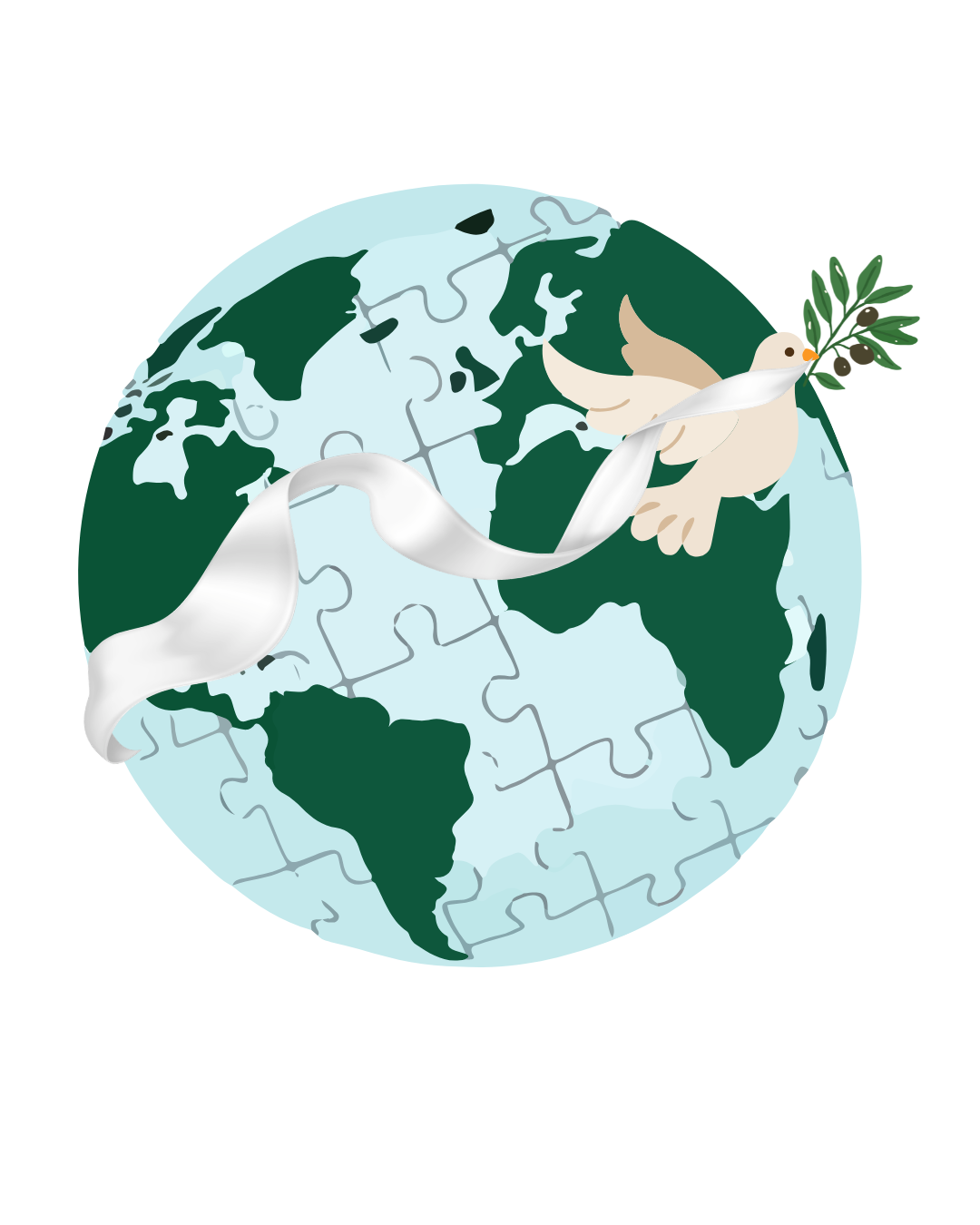
A dove carries an olive branch around a puzzle-piece globe, symbolizing global peace and unity.

Dear family of friends,

Those of you who come to synagogue often and are familiar with the liturgy may have noticed that I rarely recite the traditional Aleinu prayer at the end of services. We have a beautiful version in our prayer book in which we acknowledge the “Master of All, who suspends the heavens and establishes the earth…. This is our God,” we say, “there is none else.” I prefer this to the version that praises God who has “not made us like the other nations, nor like the families of the earth, who has not made our portion like theirs, and our fate like all their multitudes.” Not only do I find the traditional sentiment distasteful, I find it to be essentially false in an important way. While religious exclusivists may claim that we alone pray to the True God on a mystical level, a quick look at the world around us reveals that Creation could not possibly have been made for us alone, and our fate is inevitably and inextricably tied to all the peoples of the earth. 

Rabbi Zalman Shachter Shalomi of blessed memory (1924–2014)1 came up with a clever way to solve this quandary without interfering with the familiar flow of the prayer. The repeated word שֶׁלֹּא (shelo’ ) – meaning “who has not” made us like the others, and “has not” made our fate like theirs, sounds almost identical to the word שֶׁלּוֹ (shelo) – which means “his,” or “for him.”2 Reb Zalman thereby cleverly inverts the meaning of the prayer. We are no longer praising God for making us different from everyone else, but rather, praising God who, for His own glory, made us just like everyone else!3
 
Of course, ours is far from the first generation of Jews to wake up to this reality. The Talmud itself, while it takes a strict stance on worshipping other gods, nonetheless states clearly “In a town where Gentiles and Jews live together, one appoints overseers of charity from Gentiles and Jews; one provides for the Gentile and Jewish poor, visits Gentile and Jewish sick, buries Gentile and Jewish dead, and consoles Gentile and Jewish mourners… mipnei darchei shalom  – for the sake of peaceful coexistence” (Yerushalmi Gittin 5:9, cf. Bavli Gittin 61a). To my mind, this emphasis on ways of peace relates to another important Talmud principle, articulated by none other than the great Rabbi Hillel: “do not separate yourself from the community” (Avot 2:4).

We, the Jews of Taunton, have always seen ourselves as a part of the broader community. For years we hosted a regular BINGO game at the Jewish Community House, which drew participants from all over the Taunton area. As the rabbi of this community, I serve with the Greater Taunton Clergy Association, and was honored to provide the opening words at the community-wide Rev. Dr. Martin Luther King Jr. Day Celebration in January. Last year, the city invited me to give the invocation at the Veterans’ Day ceremony, and city politicians have attended our fundraisers and celebrations, such as my installation and the lighting of our menorah on the green. I believe that our commercial relationships with the broader community, such as inviting local businesses to advertise in our New Year’s Greeting Book and hosting the Taunton Girls Softball League at our Jewish Community House are also darchei shalom – ways of peace, and, of course, we follow the guidance of the Talmud when we contribute our grocery store gleanings to the Mathew Mission food pantry at First Parish Church. 

I look forward to building on these relationships. On the first Friday of this month, we will welcome members of our regional community into our sanctuary, as we host a Pride Shabbat service in collaboration with the South Coast LGBTQ+ Network, and the board is working on plans to provide other programs of interest to expand the circle of our family of friends: internally, locally, and to the Greater Taunton area. I hope you’ll join us as we continue building our ways of peace.

~Reb Josh


1 Our congregation happens to have a connection with Reb Zalman, as he came to be known. He held his first rabbinic post in New Bedford, MA, from which position he served on a rabbinic court to adjudicate some dramatic tensions in our community at the beginning of Rabbi Korff’s tenure.

2 I recently realized Reb Zalman did not originate the pun of "לא/not" and "לו/to him." A phrase in Psalm 100, verse 3, literally reads “It is He who made us and not we ourselves,” which is a slightly odd sentiment, when you stop to think of it — although the King James and other older Christian translations translate the phrase this way nonetheless. But the scholarly Jewish manuscripts from about a thousand years ago known as the Masoretic Text include a footnote suggesting that the word “לא/not” in that verse might be a scribal error, and should be read as “לו/to him” – resulting in the sentence “it is He who made us, and we are his,” which makes more sense, and Jewish translations (and some more recent Christian ones) follow this tradition. See here for the importance of Psalm 100 in Zalman’s journey towards universal faith.


3 I would gladly use this solution in our prayers if our translation reflected it, but with the prayer written as it is in both Hebrew and English, I fear the adjustment would be so subtle that only I would know I'd made it.